+86-18367343973

 English
 Español
 عربى
Article Directory
- 1 The Basic Formula of WPC Hollow Decking
- 2 The Organic Fiber: Wood Flour, Bamboo, and Rice Husk
- 3 The Thermoplastic Resin: The Matrix That Holds the Composite Together
- 4 The Additive Package: Small Percentages, Large Performance Differences
- 5 Hollow Geometry: How Material and Profile Work Together
- 6 Capped and Coextruded Structures: A Second Layer That Changes the Surface
- 7 What to Check Before Buying WPC Hollow Decking
A buyer comparing two identical-looking WPC hollow decking samples for a lakefront project quickly spots the differences. One board flexes under heel pressure, lets water soak into the cut edge, and turns chalky after a few weeks in direct sun. The other holds its shape, resists moisture, and keeps its color. The profile is the same; the material recipe is not. This guide breaks down the materials that go into WPC hollow decking and explains why each one matters in practice.
The Basic Formula of WPC Hollow Decking
Wood-plastic composite (WPC) hollow decking is not a single material. It is a blended system made from three groups of components:
- Organic fiber, usually wood flour, bamboo fiber, or rice husk
- Thermoplastic resin, most often HDPE, PP, or PVC
- Additives, including coupling agents, UV stabilizers, pigments, lubricants, and biocides
Fiber content typically ranges from 40% to 70% by weight, resin from 25% to 55%, and additives from 2% to 8%. The balance determines whether a board behaves more like wood or more like plastic. Too much fiber produces a brittle board that swells at the ends; too little fiber produces a heavy, plastic-looking surface that loses the wood aesthetic. The best formula keeps enough resin to encapsulate the fiber and enough fiber to deliver stiffness and a natural grain.
The Organic Fiber: Wood Flour, Bamboo, and Rice Husk
The fiber fraction gives WPC decking its wood-like appearance, its graining, and much of its stiffness. It also lowers the cost per kilogram of the finished board. The type and quality of the fiber are among the first things a buyer should check.
Wood Flour
Wood flour is the most common fiber in WPC decking. It is finely ground sawdust, usually from pine, poplar, or mixed hardwoods, with particle sizes in the 40 to 80 mesh range. Finer particles create smoother surfaces and better detail at the edges; coarser particles improve rigidity but can reduce impact resistance. Because wood flour is hygroscopic, it must be dried before extrusion and sealed inside enough resin to block moisture from entering.
Bamboo Fiber
Bamboo fiber is popular in Asia, where bamboo grows quickly and in large volume. It has higher tensile strength than most wood flour and produces a distinctive, often darker surface grain. Bamboo-based WPC tends to be denser, which improves fastener holding but adds weight. For hollow profiles, this translates into stiffer ribs for the same wall thickness, provided the resin matrix bonds well to the fiber.
Rice Husk
Rice husk is a low-cost agricultural by-product with a high silica content. The silica improves dimensional stability and gives some resistance to termites, but it accelerates wear on extrusion tooling and can leave a rougher surface unless the board is capped. Rice-husk composites are most common in budget-oriented decking lines.
| Fiber type | Typical loading | Advantages | Main limitation |
|---|---|---|---|
| Wood flour | 45-65 wt% | Natural grain, low cost, good stiffness | Absorbs moisture if under-encapsulated |
| Bamboo fiber | 45-65 wt% | High strength, smooth finished surface | Color variation between batches |
| Rice husk | 40-60 wt% | Very low cost, silica-based stability | Higher tool wear, rougher surface |
The Thermoplastic Resin: The Matrix That Holds the Composite Together
The resin is the continuous phase that surrounds the fiber, protects it from moisture, and gives the board toughness. It also determines how the decking behaves under heat, cold, and UV exposure.
- HDPE is the dominant matrix in WPC decking. It balances stiffness, impact strength, and weatherability, and it processes well at normal extrusion temperatures. Recycled HDPE is common, which lowers cost and improves the environmental profile, but the proportion of recycled material affects melt flow and long-term consistency.
- PP is stiffer and melts at a higher temperature, which helps in hot climates. It is often used in engineered or coextruded profiles, but it bonds less easily to fiber and depends more on the coupling agent.
- PVC appears when a manufacturer uses the same compounding line for interior panels, siding, and composite decking. PVC-based WPC is denser and has strong moisture resistance, but it requires careful stabilizer chemistry.
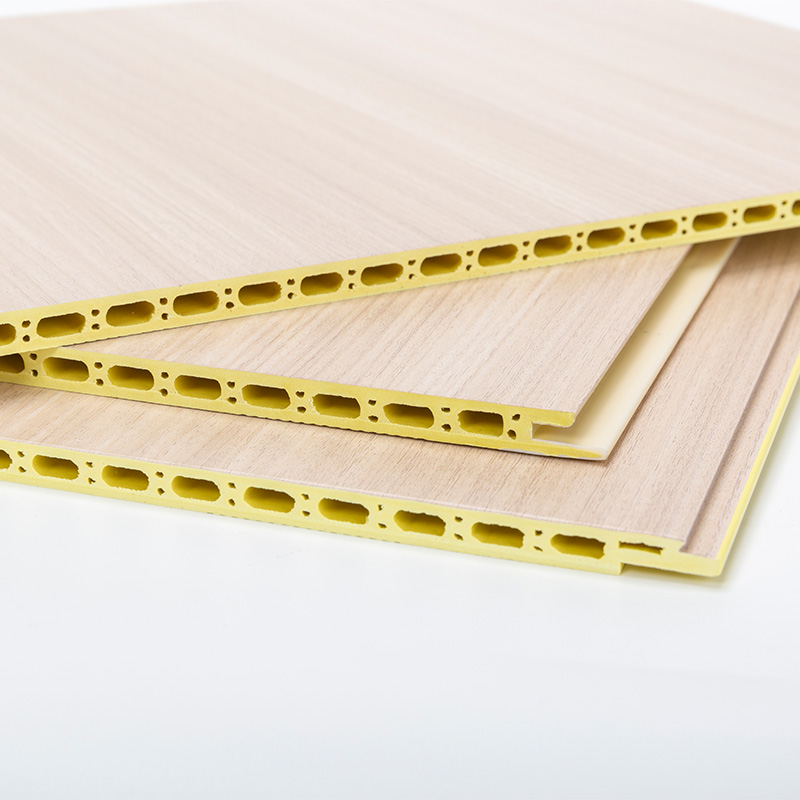
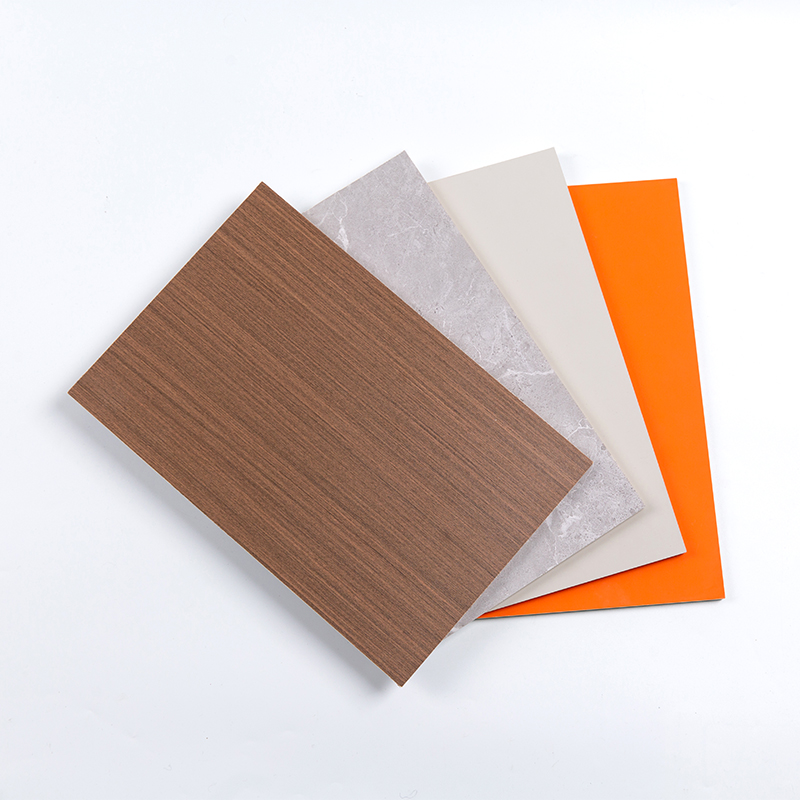
A practical way to evaluate a decking supplier is to look at the rest of its WPC range. The same HDPE matrix and fiber dispersion that go into hollow decking also appear in the company's WPC plastic-wood boards, which are produced on comparable extrusion lines. If those boards show pitting, rough grain, or uneven color, the decking will likely have the same defects.
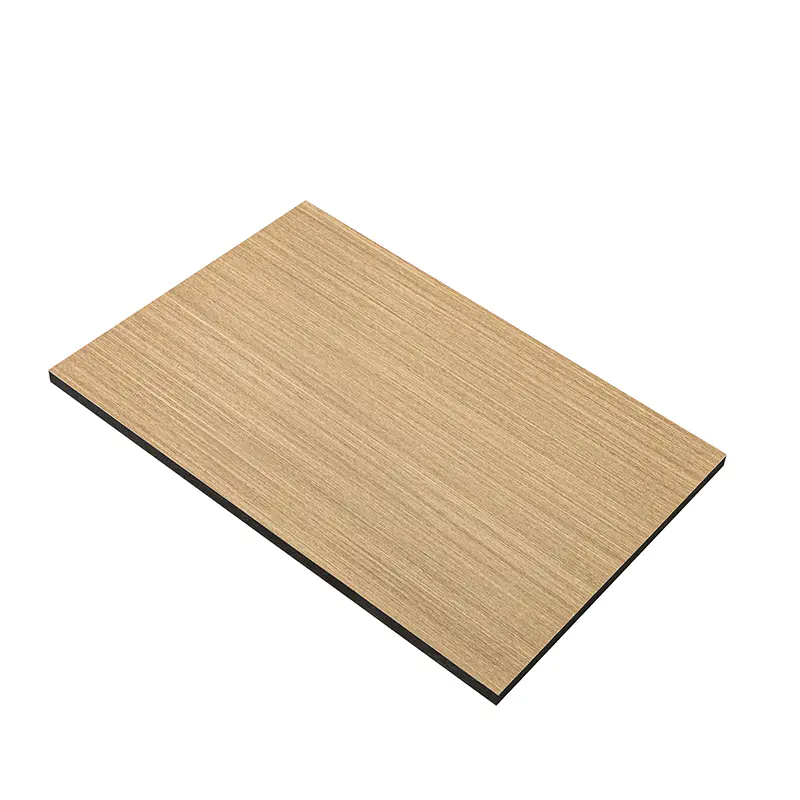
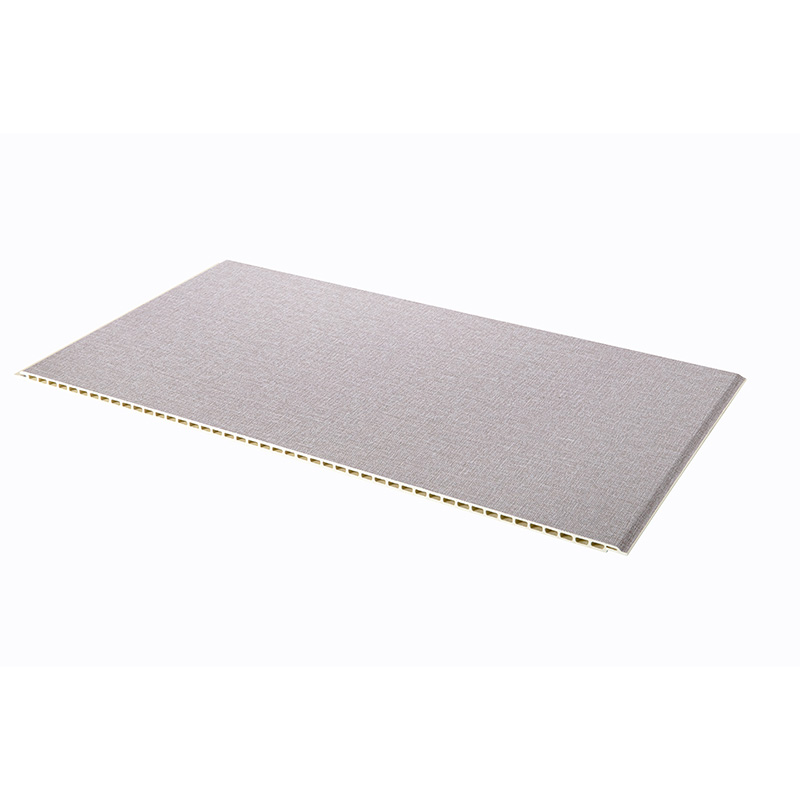 YXWPC409-2 Eco-Friendly Board Wpc Wood Veneer Boards With Wood Texture For HotelHaining Yunxi New Material Technology Co., Ltd Offer YXWPC409-2 Eco-Friendly Board Wpc Wood Veneer Boards With Wood Texture For Hotel/Hou...View Product →
The Additive Package: Small Percentages, Large Performance Differences
Additives represent only 2% to 8% of the blend, but they decide whether a board survives a decade outdoors or degrades in two seasons.
Coupling Agents
The most important additive is the coupling agent, usually maleic anhydride-grafted polyethylene (MAPE). It creates a chemical bridge between the hydrophilic wood fiber and the hydrophobic resin. Without it, water creeps along the fiber-resin interface and the board loses strength over time. A good coupling system can improve flexural strength by 20% to 40% and reduce creep under sustained loads.
UV Stabilizers and Pigments
Hindered amine light stabilizers (HALS) and UV absorbers slow color fade and surface oxidation. Iron-oxide pigments, which are inherently UV-stable, are preferred for earth tones; organic pigments deliver brighter shades but need stronger stabilization. The combination determines whether a deck fades evenly or develops a chalky gray surface.
Lubricants, Biocides, and Foaming Agents
Lubricants keep the melt moving through the die and directly affect the surface finish. Biocides protect the fiber fraction from mold and mildew, which is critical for hollow profiles because the internal channel can trap moisture. Foaming agents create a cellular core in some hollow boards, reducing weight and material cost while the outer walls carry the load.
Hollow Geometry: How Material and Profile Work Together
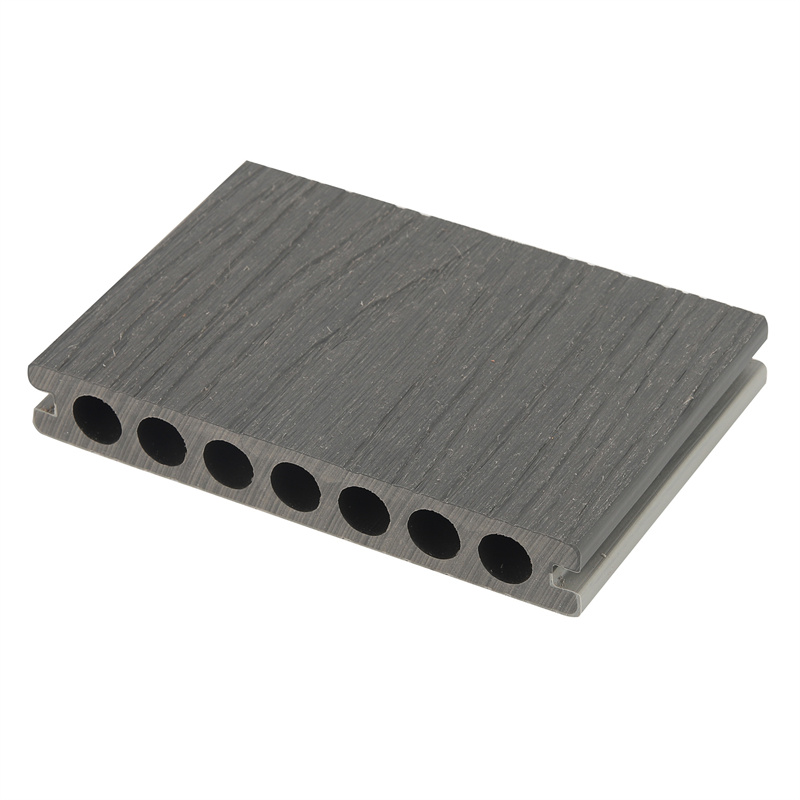
Hollow decking uses less material than a solid board of the same width, which lowers weight and cost. In exchange, the profile must do more work. The outer walls, typically 2 to 5 mm thick, carry most of the bending load, and internal ribs prevent local buckling and spread point loads from deck chairs, planters, and concentrated foot traffic.
Wall thickness and material quality are directly linked. A thick profile made with a poorly coupled composite will still crack around fasteners; a thin profile made with a well-formulated HDPE matrix and strong fiber bonding can perform reliably for years. Evaluate both together rather than choosing on density alone.
Two questions come up in most purchasing discussions. On strength: hollow decking is often fine for residential projects, but high-traffic commercial installations usually require solid or capped profiles with engineered rib patterns. On moisture: most profiles rely on drainage slots and end caps, but cut ends should always be sealed to stop moisture from wicking into exposed fiber.
Capped and Coextruded Structures: A Second Layer That Changes the Surface
The biggest material upgrade in WPC decking is the coextruded cap layer. A capped board contains two different materials: a core made from the standard WPC blend and a thin outer shell, typically 0.3 to 1.0 mm, made from a highly pigmented polymer with extra UV stabilizers and water-repellent additives.
How the Cap Is Applied
The cap is applied through coextrusion, in which two melt streams feed through the same die and fuse into a single profile. The core and cap bond at the molecular level, so the cap does not peel like a painted coating.
What the Cap Changes in Practice
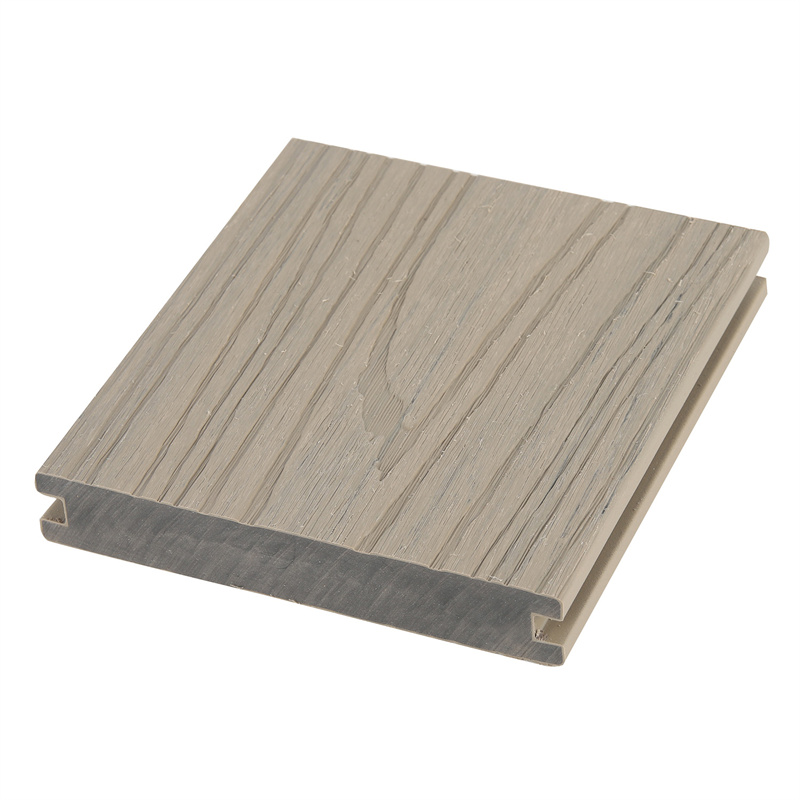
A capped surface resists stains, slows fading, and blocks moisture from entering the deck surface. It also provides a smoother, denser walking surface that is less likely to splinter. The same coextrusion technology is used for exterior wall cladding; the company's coextruded WPC panel pairs a WPC core with a protective outer shell, and the layer structure is comparable to what a capped decking board offers.
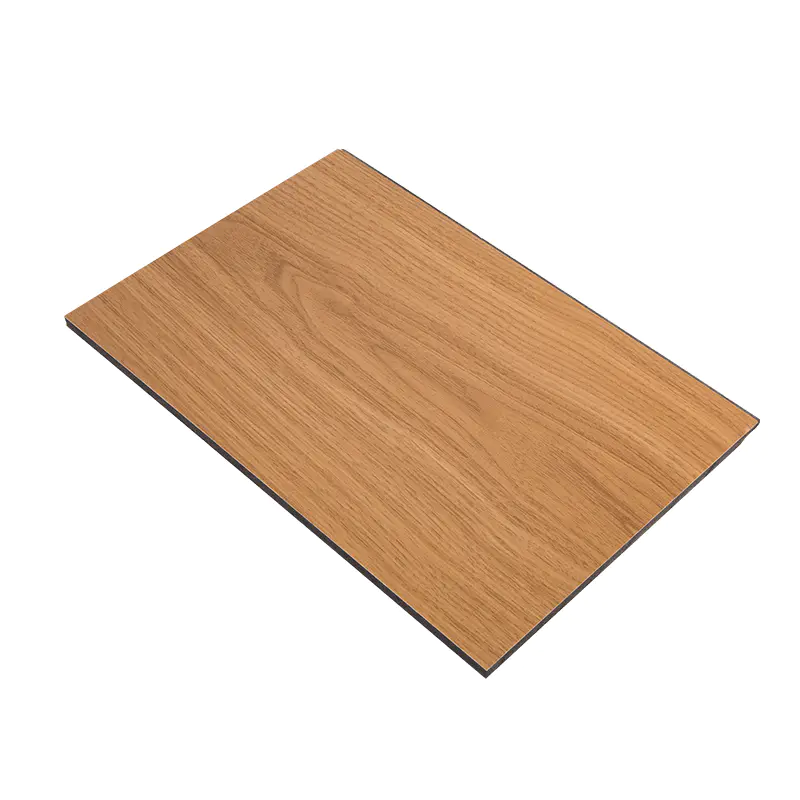 Co-Extrusion Outdoor Composite WPC Panel YXWPC1225-T Manufacturers, FactoryHaining Yunxi New Material Technology Co., Ltd Offer Co-Extrusion Outdoor Composite WPC Panel YXWPC1225-T, We Are China Co-Extrusion Outd...View Product →
What to Check Before Buying WPC Hollow Decking
Once you understand the material system, evaluating a supplier becomes a matter of verification rather than guesswork.
- Ask for the full formulation: fiber type and loading, resin type, coupling agent, and UV package.
- Request independent test data for water absorption, flexural strength, thermal expansion, and UV color retention.
- Check whether the board is capped and ask for the cap thickness and polymer type.
- Measure the wall thickness of a cut sample with a caliper and look for uniform walls and fully filled ribs.
- Weigh samples of the same nominal size from different suppliers; large density differences indicate different fiber loading or air content.
Be cautious if a supplier cannot name its resin or coupling agent. The same caution applies to samples that are only stored indoors; ask for weathered samples or test data. For more detail on how WPC behaves outdoors, see this guide to waterproof wood-plastic composite boards for outdoor use and this practical overview of maintaining WPC siding and cladding.
WPC hollow decking is a defined material system, not a vague "wood-plastic" label. When you can identify the fiber, the resin, and the additive package, you can understand why one board fails and another lasts. That understanding is what separates a decking purchase based on color swatches from one based on engineering.