+86-18367343973

 English
 Español
 عربى
عربى
Article Directory
Quick Answer
WPC wall panels are decorative and structural cladding boards manufactured from a composite of wood fiber (or wood flour) and thermoplastic polymer — typically polyvinyl chloride (PVC), polyethylene (PE), or polypropylene (PP) — extruded together to produce a rigid, moisture-resistant panel that mimics the appearance of natural wood without wood's susceptibility to rot, warping, or insect damage. They are worth it: a quality WPC wall panel system offers a 25–30 year service life with minimal maintenance, outperforms painted MDF and natural timber cladding in moisture-exposed environments, and can be installed by a competent DIYer in a single day without specialist tools.
Material
Wood fiber + thermoplastic polymer
Service life
25–30 years
Typical wood content
50–70% by weight
Standard panel width
150–200 mm
Installation method
Click-lock or screw-fix
What Is a WPC Panel — Composition, Types, and Properties
WPC stands for Wood Plastic Composite (or Wood Polymer Composite). The material is produced by blending dried wood fiber or rice husk flour with a thermoplastic binder at high temperature and pressure, then extruding the mixture through a die that shapes it into the panel profile. Additives — UV stabilisers, coupling agents, lubricants, and colourants — are compounded into the melt to modify specific performance characteristics.
The polymer binder determines the performance ceiling of the composite:
- PVC-based WPC is the most common wall panel type. PVC's inherent flame-retardant properties and dimensional stability make it the preferred choice for interior cladding, particularly in fire-rated applications. PVC WPC panels achieve Class B fire ratings (EN 13501-1) without additional coatings. They are also the most paintable and finishable of the WPC types, accepting direct adhesion of further coatings if required.
- PE-based WPC uses polyethylene as the binder. PE composites are more flexible and impact-resistant than PVC variants, which makes them preferred for external wall cladding applications where thermal movement and impact from debris need to be accommodated. PE WPC panels are typically used in outdoor façade and garden wall applications rather than interior fit-out.
- PP-based WPC uses polypropylene, which offers higher stiffness and better UV stability than PE at elevated temperatures. Used in premium exterior cladding systems and in commercial facades where dimensional stability under Australian or Middle Eastern summer temperatures (above 60°C surface temperature) is required.
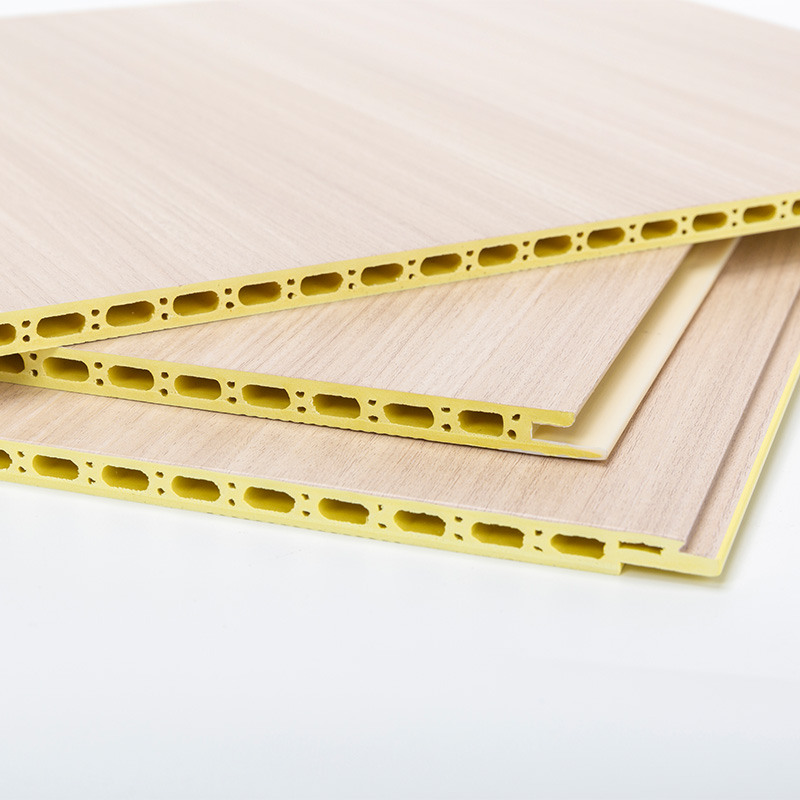
All WPC panel types share a hollow-core extrusion profile: the panel cross-section contains parallel longitudinal voids that reduce weight, improve thermal insulation, and provide a route for any water ingress to drain away rather than accumulate. A standard 150×25 mm WPC wall panel weighs approximately 2.8–3.5 kg per linear metre — about 40% lighter than a solid hardwood board of the same dimensions.
What Is WPC Wall Cladding — Interior vs Exterior Applications
WPC wall cladding is the application of WPC panels as a decorative or weathering surface over an existing wall substrate — whether interior plasterboard, exterior masonry, timber frame, or steel stud — to achieve a wood-texture finish without the maintenance requirements of natural timber. The term "wall cladding" distinguishes wall-plane applications from WPC decking (horizontal walking surfaces) and WPC fencing.
| Application Type | Environment | Recommended WPC Type | Key Performance Requirement |
|---|---|---|---|
| Interior feature wall | Dry, climate-controlled | PVC-based | Fire class B, aesthetic finish quality |
| Bathroom / wet room | High humidity, splash zones | PVC-based, fully sealed | Zero water absorption, mould resistance |
| External facade — residential | Rain, UV, thermal cycling | PE or PP-based | UV stability Class 7+, thermal movement allowance |
| External facade — commercial | As above, higher wind load | PP-based or reinforced PE | Wind load resistance, fire classification EI30 |
| Garden wall / boundary screen | Full weather exposure | PE-based | Impact resistance, UV fade resistance |
Interior WPC wall cladding has seen the fastest growth in residential renovation over the past decade. A 10 m² feature wall in a living room or bedroom installed with PVC WPC tongue-and-groove panels on a direct-fix batten system typically takes 4–6 hours for a competent DIYer and costs £200–£450 in materials — compared to £600–£1,200 for equivalent solid oak tongue-and-groove panelling and significantly less maintenance effort over the installed life.
How to Install WPC Wall Panel — Step-by-Step Method
WPC wall panel installation follows a consistent method regardless of whether the application is interior or exterior. The two primary fixing systems — direct batten fix and adhesive fix — suit different substrate conditions and are sometimes combined on the same installation. The following describes the batten fix method, which is the most versatile and allows ventilation behind the panels on exterior applications.
01
Prepare the substrate and mark out battens
Check the wall surface for level and plumb using a 2-metre spirit level. Mark horizontal or vertical batten positions — WPC panels are installed horizontally or vertically, and battens run perpendicular to the panel direction. For horizontal panel installation, mark vertical batten positions at 400–600 mm centres. Battens should be minimum 45×20 mm aluminium or treated timber, fixed to the wall with appropriate fixings for the substrate (masonry anchors, timber screws, or plasterboard fixings at 400 mm vertical spacing).
02
Install starter channel or first panel
At the bottom of the wall (or the starting edge for vertical installation), fix a starter channel or J-channel — an extruded aluminium profile that accepts the first panel's tongue and holds it in the correct plane while creating a clean finished edge. The starter channel should be fixed level, as any deviation here compounds through the entire installation. On external applications, leave a minimum 15 mm clearance between the panel base and any horizontal surface (sill, ground, or flashing) to allow thermal movement and drainage.
03
Fix panels with hidden clips or face screws
WPC wall panels use either a hidden clip system or face-screw fixing, depending on the panel profile. Hidden clip systems insert a stainless steel or plastic clip into the groove of each panel, which is then screwed to the batten — the next panel's tongue covers the clip, producing a face that shows no fixings. Allow an expansion gap of 3–5 mm at each end of every panel run; WPC expands and contracts with temperature (approximately 3–5 mm per metre over a 40°C temperature range) and insufficient gap allowance causes panel buckling on hot days.
04
Cut panels to length and manage joints
Cut WPC panels with a fine-tooth circular saw blade (80–100 tooth TCT blade) to avoid splintering the polymer surface. Where panels must join end-to-end within a run, use a proprietary H-section joiner profile rather than a butt joint — the H-profile accommodates the expansion gap while maintaining a clean line. On external applications, seal all cut ends with a cut-end sealant (PVC primer-sealer or exterior wood sealant applied to the cut face) to prevent moisture ingress into the hollow core channels from exposed cross-sections.
05
Finish corners and edges with trim profiles
WPC wall panel systems are supplied with a complete range of matching trim profiles — internal corners (L-angle), external corners (F-trim or purpose-designed corner post), window and door surrounds, and top-of-wall capping. Using the manufacturer's proprietary trim system rather than improvising with general-purpose timber mouldings ensures colour and texture match and maintains the weathering performance of the installation. Corner posts should be fixed to the wall independently of the panels, with panels butting into the post groove and allowing the same thermal movement gap.
Are Wall Panels Worth It — WPC vs Alternative Wall Cladding Options
Whether WPC wall panels are worth the investment depends on the comparison point. Against painted plasterboard or bare masonry they are a clear aesthetic upgrade. Against natural timber, ceramic tile, or stone cladding the calculation involves material cost, installation cost, maintenance cost over the installed life, and durability in the specific environment. The table below provides a direct comparison across the most common residential wall finish options:
| Material | Material Cost (per m²) | Installation Difficulty | Maintenance Requirement | Lifespan |
|---|---|---|---|---|
| WPC wall panel | £20–£55 | Low–Medium (DIY-friendly) | Very low — occasional wash | 25–30 years |
| Solid hardwood cladding | £60–£150 | Medium–High | High — annual oiling/staining | 20–50+ years (with maintenance) |
| PVC/uPVC cladding | £10–£25 | Low | Very low | 20–25 years |
| Ceramic or porcelain tile | £15–£80 | High (professional recommended) | Low — periodic grout cleaning | 30–50 years |
| Painted MDF panelling | £8–£20 | Low–Medium | Medium — repainting every 5–8 years | 10–15 years |
| Natural stone cladding | £80–£200+ | High | Low–Medium — periodic sealing | 50+ years |
The WPC wall panel occupies a strong value position: lower material cost than hardwood with comparable longevity, significantly lower maintenance burden than any natural material, and higher perceived quality than plain PVC cladding. For wet-room and bathroom applications in particular, WPC panels are worth it on maintenance cost alone — a WPC-clad bathroom wall requires no grouting, no sealing, and no repainting over its installed life.
Maintaining and Cleaning WPC Wall Panels
One of the principal reasons WPC wall panels are worth choosing over natural timber or painted surfaces is the minimal maintenance they require. The guidelines below cover routine cleaning, stain removal, and the conditions that indicate a panel needs replacement rather than cleaning:
- Routine cleaning — annual wash with mild detergent: Wipe down interior panels with a damp cloth and dilute neutral detergent (pH 6–8) annually. For exterior panels, a garden hose at normal pressure is sufficient to remove loose dirt and biological growth. Avoid high-pressure washing above 60 bar at close range — the mechanical force can force water into the hollow core channels via cut ends or joint gaps and is not required for normal cleaning of a WPC surface.
- Mould and algae removal on exterior panels: Biological growth on exterior WPC panels (green algae, black mould) does not damage the panel but is unsightly. Apply a proprietary wood-safe biocidal cleaner, allow to dwell for 15–30 minutes, then rinse. Products containing quaternary ammonium compounds or benzalkonium chloride are effective on WPC surfaces. Do not use bleach-based cleaners at concentrations above 1% — stronger bleach concentrations can bleach the UV pigment in the panel surface, causing localised colour change.
- Scratch and surface damage: Light surface scratches on WPC panels do not expose a different material underneath — the colour and texture extends through the full thickness of the panel face. Deep gouges that break through to the hollow core should be filled with a matching-colour exterior silicone or polyurethane sealant to prevent water ingress into the hollow section. WPC panels cannot be sanded and refinished like natural timber — the polymer surface does not accept stain penetration.
- When replacement is needed: WPC panels should be replaced when they show structural cracking across the full panel width (caused by severe impact), sustained delamination of the face coating (UV degradation of low-quality panels), or persistent discolouration that does not respond to cleaning (indicating deep-seated biological contamination in a damaged panel). Individual panels in a click-lock system can be replaced without disturbing adjacent panels, provided the batten spacing was installed to the manufacturer's standard.